
What is what? and what is a framer?
Flat track is still a young sport in Europe and maybe even more in the Northern countrys. Only a very few has been doing it for more than ten years and most of us much less than that. In the early 2020’s the Swedish federation invited a few riders/race organizers to create a rulebook with classes, race and safety requirements adapted to flat track not speedway as it used to be. A great opportunity for the flat track community and also a way to create classes to be able to offer a great varaity with something for almost any kind of bike and any level of skills. The first rules that got published where mostly recommendations and a way to get more riders interested in a specific class, to either build a bike or modify the one they already had. Along the way riders interpret rules either literally or as it was intended.
Recommendations purely, sometimes creates unfair rules when riders use the literally version instead of the intention and therefore the rule book has to be updated once in a while. To keep the originally intention of the class as well as follow other countrys changes in rules.
When creating rules you can do as you like or to try to make them as fair and equal as possible. To make them as fair as possible and also equal to other countrys Sweden has follewed that path. For the same reasons many other countrys as well has therefore divided their rules in two sections; Open classes referring to the riders skill mostly and the other type is where the bike type itself tells you what class you should sign up for.
This division of classes seems to be a bit confusing according to ongoing discussions in social medias so we will try to explain what is what and also why.
The first division of classes are the open ones:
Youth
Junior
Newbie
Rookie
Intermediate (former Amateur in Sweden)
Expert (Former Pro in Sweden)
Supergirl
All this classes are about the riders skills and as in youth and junior also the riders age and as in Supergirl also the riders gender. There are in all of them some basic requirments of cc’s, saftey devices as well as tire requirements in the higher levels. Besides that basically any rider and any bike can participate. Thats why they are called Open classes.
As in any sport when the level of the riders skills increases the gear does the same in some mysterious way. In reality that basically means that the higher the level gets, the bikes seems to be more alike due to whats most efficant to have a slight chance of the podiums. Thats what development are about, especially in sports.
The second divison of classes are the bike type division
Vintage including
Vintage True Gold – mostly ridgid frames no OHC and as much as possibly with the original features of the bike kept.
Vintage Real Deal including the real flat track bikes from 60’s and 70’s when the sport developed and lots of riders had purpose built bikes for flat track, among them Champion Yamahas, Woods as well as Redline and many more. One can say that Vintage Real Deal and Thunderbike are the same, just from different eras in time.
Vintage Modern Classic is a very wide open class but referrs from mid 70’s to mid 80’s and are ment for stock bikes from that time. Only a few adjustments are allowed such as seat pans, front fork and suspension. No actually changes of main frame are allowed. This is a great class and offers good racing possibilitys for very little money, still.
For more modern bikes there are now three classes
Hooligan – Factory Twins with only small modifications allowed such as seat pan, gas tank, front fork and suspension. No changes of main frame are allowed and engines has to be stock at least 750 cc.
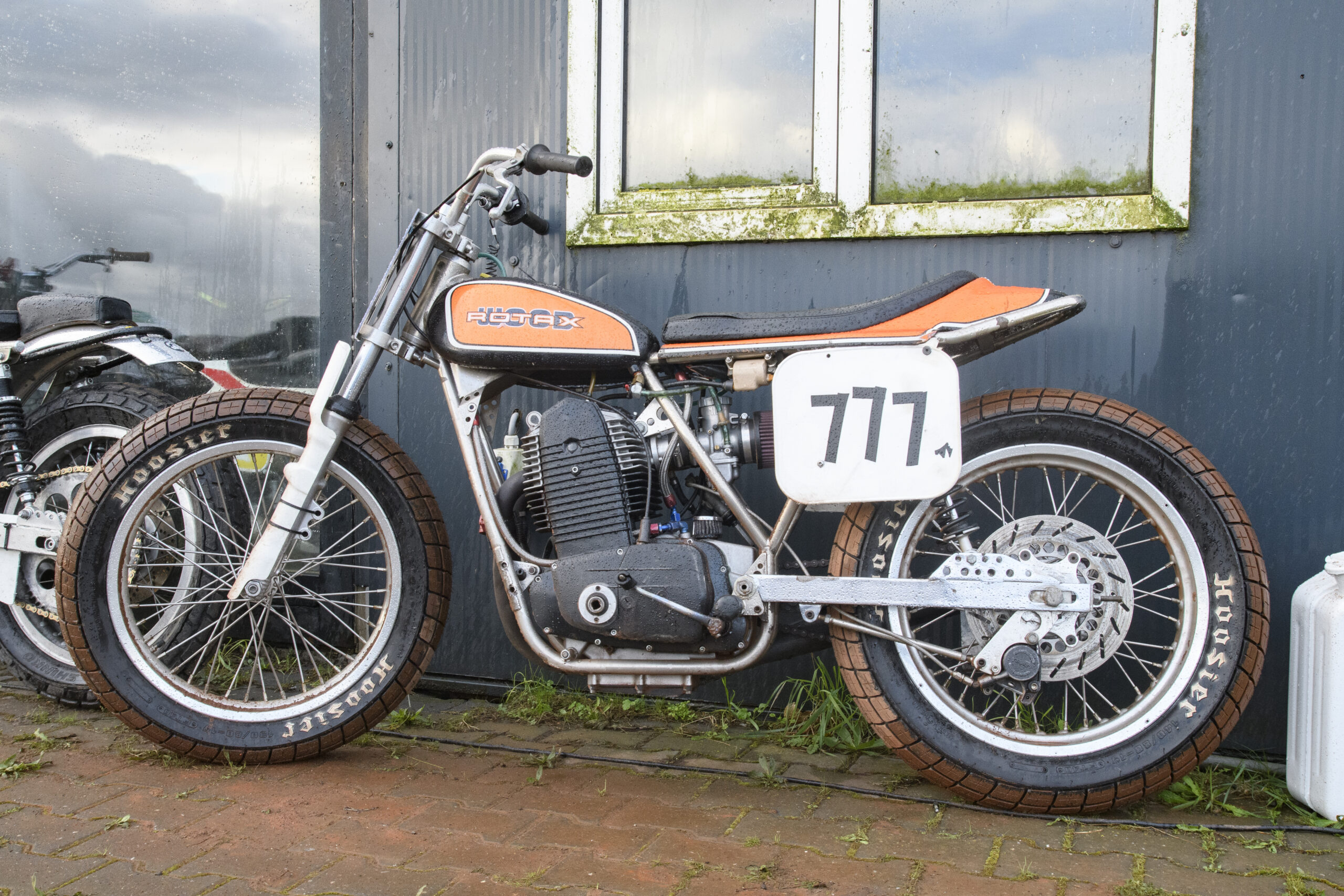
Thunderbike – The class was originally invented in UK to prevent mixing modified DT MX-bikes from the more vintage styled flat trackers with heavier frames. IN US they dont race Thunderbike, instead most framers are nowdays considered vintage but in Europe to cover bikes that are newly built as replicas of the old framers Thunderbike is a good alternative. So what is a framer? It basically means a purpose built flat tracker from either a special built frame or a heavily modified original frame. Bikes, with angles and chassie set up for flat track. In Sweden we this year lowered the engine size due to follow the development in other countrys and since many is building framers with 450 cc engines nowdays it was a natural change. In some coutrys like UK they dont allowed engines from DT MX bikes though so if you are aiming to race abroad, stay on the safe side and go for an old school single like the Rotax 604, Honda XR 600, Yamaha TT 600 or equal. Most other countrys clarifies that no DT MX frames are allowed. If you like to race a modified DT MX – the open classes is your choice. Having a framer you can race both Thunderbike and open classes and if you are the lucky owner of a Vintage framer – earlier than mid 70’s you have three options, Vintage real deal, Thunderbike and open classes.
DT MX is new this year since the former Pro now Expert is open to anyone skilled enough. The DT MX class has a maximum cc as 450 cc four stroke and 500 cc two stroke. This means stock bike with no electronic riding modes changes allowed during the race, no tire cutting and so on. This class is very much alike the FIM-specs for a flat track bike, just not as detailed.
At the moment we belive that most organizers will run this class along with the Expert class since most of the fastests riders are on a 450 cc DT MX bike. With the increasing amount of riders there will most likely be a split of the two classes in the future though.


A typically modern framer suited for Thunderbike.
Share this content: